
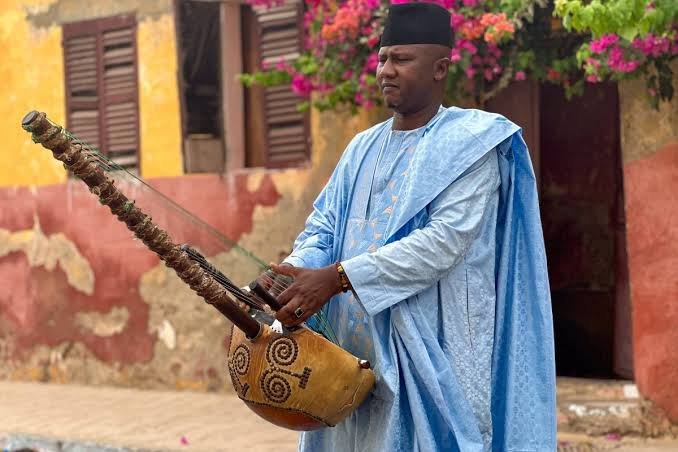
Long before recording studios existed, entire histories, genealogies, and moral lessons were preserved and passed down through music. The griot tradition West Africa is known for remains one of the most important oral and musical practices on the continent, and its influence continues to echo through contemporary genres, songwriting styles, and performance traditions today.
Who Are Griots?
Griots are hereditary musicians, storytellers, and oral historians found across parts of West Africa, particularly within Mande-speaking communities in countries such as Senegal, and historically linked to the broader Mali Empire region. Traditionally, the griot role was passed down within specific families, with knowledge, repertoire, and technique taught from one generation to the next rather than learned through formal outside instruction.
A griot’s role extended well beyond entertainment. They served as historians, genealogists, advisors, and mediators, using music and spoken word to preserve community memory, celebrate lineage, and mark significant life events such as marriages, births, and honorary titles.
The Instruments Associated With Griot Music
- The kora — a long-necked harp-lute with a large calabash resonator, known for its intricate, cascading melodic lines.
- The balafon — a wooden xylophone-like instrument with gourd resonators, used to accompany storytelling and praise singing.
- The ngoni — a smaller stringed lute considered by many historians to be an ancestor of instruments found in other string traditions around the world.
These instruments were not simply musical accompaniment, they were tools of memory, often used to structure long oral narratives and reinforce historical detail through repeated melodic patterns.
Why the Griot Tradition Still Matters
The griot tradition offers a model of music as functional cultural infrastructure rather than pure entertainment. Songs were used to record history, resolve disputes, and reinforce social values, a role quite different from the primarily commercial function much of contemporary popular music serves. Understanding this distinction helps explain why griot music is often approached with a level of reverence and formality not always applied to other performance traditions.
The Griot Influence on Contemporary African Music
Elements of griot tradition continue to surface in modern West African music, both directly and indirectly:
- Praise singing structures appear in some contemporary songs that honor specific individuals, families, or achievements.
- Storytelling-driven lyricism echoes the griot emphasis on narrative and historical detail rather than purely abstract themes.
- Instrumental sampling of the kora and balafon appears in some modern productions seeking a distinctly West African melodic texture.
- Call-and-response vocal patterns, long used in griot performance, remain common across many contemporary African genres.
Griot Tradition Compared to Contemporary Popular Music
| Aspect | Griot Tradition | Contemporary Popular Music |
| Primary Function | Historical record-keeping, social mediation | Entertainment, commercial release |
| Transmission | Passed within hereditary families | Learned through formal or informal training |
| Core Instruments | Kora, balafon, ngoni | Varies widely, often electronic or hybrid |
| Lyrical Focus | Genealogy, history, praise | Broad range of contemporary themes |
Practical Tips for Exploring Griot Music Today
- Seek out recordings and performances from musicians who identify as coming from griot lineage, rather than relying solely on secondhand interpretations.
- Pay attention to the structure of praise songs, which often follow recognizable patterns rooted in oral historical tradition.
- Learn the basic function of the kora, balafon, and ngoni to better understand their role within a performance, not just their sound.
- Approach griot music as a living tradition still practiced today, rather than a purely historical artifact.
Conclusion
The griot tradition represents one of the most sophisticated oral and musical systems in West African cultural history, one built specifically to preserve knowledge across generations through song. Its influence, whether heard directly through instruments like the kora or indirectly through storytelling-driven lyricism, continues to shape West African music today.
Final Thoughts
As global audiences discover more West African music, understanding the griot tradition offers important context for why storytelling, lineage, and communal memory remain such consistent themes across the region’s musical output, both traditional and contemporary.
Frequently Asked Questions
What exactly is a griot?
A griot is a hereditary musician and oral historian in West African tradition, responsible for preserving history, genealogy, and cultural knowledge through music and storytelling.
Which countries are most associated with the griot tradition?
The tradition is strongly associated with Mande-speaking communities, particularly in Senegal and historically linked to the wider Mali Empire region of West Africa.
What instruments are central to griot performance?
The kora, balafon, and ngoni are among the most closely associated instruments, each serving specific roles in accompanying storytelling and praise singing.
Is the griot tradition still practiced today?
Yes, griot families continue to practice and pass down the tradition, and elements of griot performance style continue to appear in contemporary West African music.
How has griot tradition influenced modern African music?
Its influence can be seen in storytelling-driven lyrics, praise singing structures, call-and-response vocal patterns, and the occasional use of traditional instruments like the kora in modern productions.